Friday, March 23, 2012

The Fourth Station of the Cross: The Truth

Courtesy: Vatican Museum
"Now Peter was sitting out in the courtyard, and a servant girl came to him. 'You also were with Jesus of Galilee,' she said. But he denied it before them all. 'I don't know what you're talking about,' he said. Then he went out to the gateway, where another girl saw him and said to the people there, 'This fellow was with Jesus of Nazareth.' He denied it again, with an oath: 'I don't know the man!' After a little while, those standing there went up to Peter and said, 'Surely you are one of them, for your accent gives you away.' Then he began to call down curses on himself and he swore to them, 'I don't know the man!' Immediately a rooster crowed. Then Peter remembered the word Jesus had spoken: 'Before the rooster crows, you will disown me three times.' And he went outside and wept bitterly." - Matthew 26:69-75 (NIV)

Peter was a bold man. As Jesus predicted His death, He also predicted that all of his apostles would run away and deny Him. Peter challenged Jesus, saying He would never leave, even to the point of death. Jesus knew better, though, and predicted:

"'I tell you the truth,' Jesus answered, 'this very night, before the rooster crows, you will disown me three times.'" - Matthew 26:34 (NIV)

Of course, when Jesus was arrested, all of the disciples ran away, despite their earlier protests and promises to the contrary (see Matthew 26:56).

In the celebration of the Stations of the Cross by Pope John Paul II in 1991, the minister prayed this prayer:

"Lord, grant us the gift of honesty that we may not fear to speak the truth even when difficult."

Thanks to sin, even the most honest of us (at least by our standards) is still capable of speaking a lie, whether it is conscious or unconscious. Peter and the other apostles were very bold in protesting when Jesus predicted their falling away, but that was also at a time of very little trouble. When the real trouble came, they fell away almost too quickly.

We need to ask God to continue to work in us so we may not only be honest and speak the truth in the best of times, but also when we may, as they say, bite the bullet and say it when it is difficult. 1 Timothy 3 tells us that overseers (also can be defined as church leaders) must be above reproach, or good to the point of being beyond criticism because we are acting like we are speaking and doing what we should be doing, bringing glory and not shame to the name of Christ.

May we all be able to do that.

(Editor's note: This is part of a series of the Stations of the Cross.)

Thursday, March 22, 2012

The Third Station of the Cross: Being Right

Courtesy: Vatican Museum
"At daybreak the council of the elders of the people, both the chief priests and teachers of the law, met together, and Jesus was led before them. 'If you are the Christ,' they said, 'tell us.' Jesus answered, 'If I tell you, you will not believe me, and if I asked you, you would not answer. But from now on, the Son of Man will be seated at the right hand of the mighty God.' They all asked, 'Are you then the Son of God?' He replied, 'You are right in saying I am.' Then they said, 'Why do we need any more testimony? We have heard it from his own lips.'" - Luke 22:66-71 (NIV)

Before the Sanhedrin, Jesus knew what He was going up against. He knew that under Jewish law, especially the way it was interpreted by the Pharisees, admitting He was the Son of God would gain him death. He knew He would not be believed because the Pharisees chose not to believe. However, when asked, He admitted it, answering "Yes" to the question, "Are you then the Son of God?"

In the celebration of the Stations of the Cross by Pope John Paul II in 1991, the minister prayed this prayer:

"Lord, grant us your sense of righteousness that we may never cease to work to bring about the justice of the kingdom that you promised."

In this life, we're going to face opposition. We're going to face persecution if we stand for something. If we're going to face opposition, we had better make sure we're facing it for a good reason.

As Christians, as followers of Christ, we know that if (and when) we face opposition and persecution, as millions of Christians do across the world, we can face it with the faith that Jesus is who He said He was: He was God (see John 14:7-10, John 10:28-33, John 14:11, among others) and that with His death on the cross, he even fulfilled Scripture (see Isaiah 53).

For that reason, we can be certain we are right in the cause we pursue, and face it with confidence, perseverance and courage.

(Editor's note: This is part of a series of the Stations of the Cross.)

Wednesday, March 21, 2012

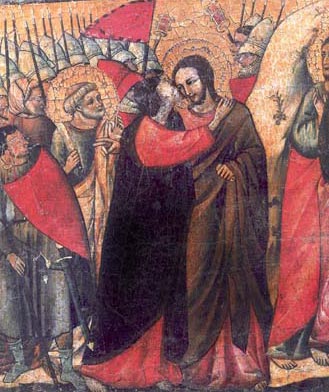
The Second Station of the Cross: Reflecting the Good News of Christ

Courtesy: Vatican Museum
"Just as he was speaking, Judas, one of the Twelve, appeared. With him was a crowd armed with swords and clubs, sent from the chief priests, the teachers of the law, and the elders. Now the betrayer had arranged a signal with them: 'The one I kiss is the man; arrest him and lead him away under guard.' Going at once to Jesus, Judas said, 'Rabbi!' and kissed him. The men seized Jesus and arrested him." - Mark 14:43-46 (NIV)

In the celebration of the Stations of the Cross by Pope John Paul II in 1991, the minister prayed this prayer:

"Lord, grant us the courage of our convictions that our lives may faithfully reflect the good news you bring."

Ever since the beginning of His ministry on Earth, Jesus knew Judas Iscariot was going to betray Him. He said as much at the Last Supper (see Matthew 26:23-25).

But Jesus knew the Father had said for Him to sacrifice Himself for the sins of the world, as part of His plan of salvation. Even when He was being arrested, He stopped His apostles from doing more than slicing the ear off the servant of the high priest, which he later healed (see Luke 22:49-51). Jesus wanted peace, even though He knew what His fate was going to be. However, He also knew that He would rise from the dead in three days (see John 2:18-22).

Since then, followers of Christ have done just that, bore up under intense persecution for their faith. Even today, followers in parts of Asia, Africa and the Middle East must suffer for their faith of the saving grace of Jesus Christ. However, they continue to do so in a peaceful manner, because they, like Jesus, know how the story ends.

Like the minister in the celebration said, may our lives faithfully reflect the good news that Jesus brought.

(Editor's note: This is part of a series of the Stations of the Cross.)

Tuesday, March 20, 2012

Today's links - March 20, 2012

-- Want to know how your Congressional Representative and Senator ranks in terms of promoting religious freedom? Open Doors USA has created a nifty scorecard for all 535 members of Congress.

-- Mixing politics and religion has tended to turn young people away from church, according to the Christian Post.

-- Contrary to stats often cited by pastors, Christians do NOT have just as high as divorce rate as the rest of the population, according to a new study.

-- Even the official churches in Iran (those allowed to exist by the Islamic government there) are facing a crackdown by the authorities.

The First Station of the Cross: Praying for God's Will

Courtesy: Vatican Museum
"Then Jesus went with his disciples to a place called Gethsemane, and he said to them, "Sit here while I go over there and pray." He took Peter and the two sons of Zebedee along with him, and he began to be sorrowful and troubled. Then he said to them, "My soul is overwhelmed with sorrow to the point of death. Stay here and keep watch with me."Going a little farther, he fell with his face to the ground and prayed, "My Father, if it is possible, may this cup be taken from me. Yet not as I will, but as you will."Then he returned to his disciples and found them sleeping. "Could you men not keep watch with me for one hour?" he asked Peter. "Watch and pray so that you will not fall into temptation. The spirit is willing, but the body is weak." - Matthew 26:36-41 (NIV)

(Editor's note: This is part of a series on the Stations of the Cross.)

In the Garden of Gethsemane, which is located at the foot of the Mount of Olives just east of Jerusalem, Jesus met with his disciples for the last time. He knew what was coming up, that He would soon endure a death He did not deserve.

In the celebration of the Stations of the Cross by Pope John Paul II in 1991, the minister prayed this prayer:

"Lord, grant us your strength and wisdom, that we may seek to follow your will in all things."

God knows life can be hard. Jesus, though He could get out of sacrificing Himself on the cross because He was God Himself, didn't, instead relied on God the Father for the strength to persevere. He asked for the Father to take "this cup" from Him, but He also relented.

"Yet not as I will, but as you will." - Matthew 26:41 (NIV)

He asks that of us as well. He knows there are temptations in the world. He knows there are hardships that we all face. But through it all, He says for all of us to follow Him, and to rely on God for that strength and for answers.

Monday, March 19, 2012

Today's links

  • Recently the Kony 2012 campaign spread around the virus, promoting the cause of fighting the recruitment of children as soldiers in Ugandan rebel Joseph Kony's army. The only problem, the information in the video that spread is horribly outdated. Among other actual facts, Kony has not been in Uganda for at least six years. 
  • Members of Campus Crusade in Japan are giving survivors of last year's earthquake and tsunami manga or comics with a story of hope to help curb a high suicide rate in that country.
  • Coptic Orthodox Pope and Patriarch Shenouda III, one of the world's most revered Christian leaders and an advocate for Christians in Muslim-dominated Egypt, has passed away at the age of 88.
  • A riveting and sad story of a former slave in the African nation of Mauritania, where slavery continues despite its official abolishment in 1981.

Free to think in Christ

"Now the Bereans were of more noble character than the Thessalonians, for they received the message with great eagerness and examined the Scriptures every day to see if what Paul said was true." - Acts 17:11 (NIV)

A friend of mine recently posted this photo on Facebook, commenting that this was a bogus thing to say. I have heard others in the past comment on this teaching, saying this translates into meaning Christian believers should be mindless robots who cannot think for themselves.

For the record, the Bible is completely against this kind of statement.
 
Isaiah recorded that God told him, "Come now, and let us reason together" (Isaiah 1:18) even as the nation of Israel was rebelling against Him. Proverbs 15:22 says, "Plans fail for lack of counsel, but with many advisers they succeed." (In other words, talk and think things through). And 2 Timothy 2:15 tells us, "Do your best to present yourself to God as one approved, a workman who does not need to be ashamed and who correctly handles the word of truth." In other words, know the Word of God and how to use it. In addition, 1 Thessalonians 5:21 says, "Test everything. Hold on to the good."

The Bible does allow us to think, contrary to popular opinion. As noted in the verse from Acts at the beginning of this note, the Bereans were noted as having "more noble character" than their neighbors, the Thessalonians because of their eagerness in reaching the teaching on Christ from the Apostle Paul. However, they were noteworthy because they looked at the Scriptures themselves.
 
In other words, they didn't take what Paul was teaching them at face value, as has been the mistake of far too many Christians in the past and in today's church. They looked at the Word of God, testing Paul on what He said. If what Paul was teaching them was not from God, then it would have been revealed to them from Scripture.
 
We can have that same reasoning, because God not only gave us all brains, but He allows us to use them as well, all for His glory (Colossians 3:17). That is true freedom.

Friday, March 16, 2012

Christ for all

Courtesy Prison Fellowship International
"There is neither Jew nor Greek, slave nor free, male nor female, for you are all one in Christ Jesus" - Galatians 3:28 (NIV)

More and more often these days, Christians are accused of being prejudiced against gays and lesbians, women, and those of other faiths. They are accused of wanting to impose a system where the tenets of the Bible are obeyed and enforced with an iron fist.

In some cases, those making those kind of accusations would be correct.

Prejudice such as racism and religious discrimination is one of the biggest ills in the world, even in the church. Bigotry has been used throughout history to enslave people, figuratively through laws or physically through chains, to bring them down, or in general, make them second- or third-class citizens. There is the racism that was prevalent in the United States that in some sectors, still exists today. There is the denial of freedom to choose and practice your own faith that is rampant throughout much of the Middle East and other parts of the globe.

However, in Christ, for those who actually follow His teachings, that prejudice is history, part of a sinful past that has been abolished by the saving blood of our Savior. For those believers who allow Christ to take hold in their lives and actually strive to follow the teachings outlined in God's Word, the Bible, it is a freedom from bigotry that can ensnare both the people they are directing it toward and themselves as well.

Yes, Christians can call out sin amongst in the world. However, they are called to love others as God loved them (see Ephesians 5:1-2), and follow Christ's example. Throughout the Gospels, Jesus called out the Pharisees and other religious leaders of the day for their sins. However, for others, he simply loved them, welcoming them and healing them of the their physical and spiritual wounds caused either by bad teaching or their own sinfulness.

The evangelist Billy Graham is one such person. During his more than 60 years of active ministry, he was able to preach in closed countries such as Eastern Europe and the former Soviet Union during the days of communism, and meet with leaders such as North Korea's Kim Il Sung and other presidents because he simply lived and preached the saving Gospel of Jesus Christ with no other agenda. During a crusade to India in 1956, his first evangelistic trip to somewhere besides the United States or Western Europe, he made the following the distinction about Jesus, as noted in his autobiography, "Just As I Am:"

"I am not here to tell you about an American or a Britisher or a European. I am here to tell you about a Man Who was born right here in your part of the world, in Asia. He was born at the place where Asia and Africa and Europe meet. He had skin that was darker than mine and He came to show us that God loves all people. He loves the people of India and He loves you."

Jesus Christ is for all people, regardless of who they are and what they have done. All you have do is reach out to Him, because He is reaching for you. If you have questions or would like to talk about Christ, please feel free to contact me.

Links in the news

  • Saint Patrick, whose days we mark on Saturday, was a practical theologian and social activist, a man truly ahead of his time.
  • The Islamic-led government in Sudan, following last July's succession by its mainly Christian and animist southern regions, has decreed that all Christians must leave the country or suffer the consequences.
  • Mail deliverers in Israel outside of Tel Aviv are refusing to deliver Hebrew-language New Testaments being given away by a unknown group.

Thursday, March 15, 2012

Standing out in a different way

"Do not think that I have come to abolish the Law or the Prophets; I have not come to abolish them but to fulfill them. I tell you the truth, until heaven and earth disappear, not the smallest letter, not the least stroke of a pen, will by any means disappear from the Law until everything is accomplished. Anyone who breaks one of the least of these commandments and teaches others to do the same will be called least in the kingdom of heaven, but whoever practices and teaches these commands will be called great in the kingdom of heaven. For I tell you that unless your righteousness surpasses that of the Pharisees and the teachers of the law, you will certainly not enter the kingdom of heaven." - Matthew 5:17-20 (NIV)

One of the main reasons often used in not wanting to believe in Christ and follow any of the moral laws on sex, life and other areas listed in the Bible is that they don't want to selectively choose which of the Old Testament laws to follow. Often when a moral law is cited, the response may be "Then why do you still eat pork?" (Leviticus 11:7) or "Do you still wear clothes of mixed fabrics?" (Deuteronomy 22:11)

However, there are differences between the dietary and ceremonial laws laid out for the Israelites in Leviticus and Deuteronomy and the moral laws that are exhibited in places such as the Ten Commandments. God laid out the law to Moses to present to the Israelites because, after the exodus out of slavery in Egypt, they were moving into a land that was possessed by people who defamed God by worshipping other gods, some sacrificing their children to the god Molech, which God condemned. He wanted His people, the Israelites to stand out, and be a holy people amongst the evil that was in the world by the world (see Exodus 19:5-6).

When Jesus came into the world, He brought with Him a new covenant with the Hebrews and the rest of the world. He came to save the world because under the Law, all people are sinners (see Romans 3:23). As the Savior of the nations, Jesus fulfilled the Law to the point where the old ceremonial laws did not apply anymore, which we see in his rebuke of the Pharisees who had condemned His followers for picking grain on the Sabbath, which was against the Law (see Mark 2:23-27). The old dietary laws also did not apply anymore, as was revealed to the Apostle Peter, as recorded in Acts 10.

In short, while still considering the Hebrews His People, He has opened the umbrella to all peoples, as referenced by John 3:16-17:

“For God so loved the world that he gave his one and only Son,[a] that whoever believes in him shall not perish but have eternal life. For God did not send his Son into the world to condemn the world, but to save the world through him." (NIV)