Showing posts with label Gospel. Show all posts

Monday, May 14, 2012

Today in Missions: Reaching out to Muslims

Source: Remnant Westside Missions
"It has always been my ambition to preach the gospel where Christ was not known, so that I would not be building on someone else’s foundation." - Romans 15:20 (NIV)

In many parts of the world, at least by the world's standards, it is inadvisable to talk about Jesus Christ because of the possibly violent reaction it could get from those who are hearing it. However, the possibility of a bad reaction to the Good News has not stopped believers from going out to dangerous parts of the world and preaching the message of reconciliation to those who may not want to hear it.

Today we speak with "Josie," a young woman from Iowa who is working among the Arab Muslim population in the Detroit area. We have changed her name to protect her anonymity as she aspires to soon go to the Middle East, where speaking out as a Christian, and particularly as a Christian woman, can be dangerous work.

Disciple Beacon: Tell the story of how you came to Christ.

Josie: I grew up thinking that being a Christian meant conforming to the rules made by men who led our community and being a good person who loves God. As a young kid, I had this attraction to God and knew that I wanted to be pleasing to Him. I pursued my only way of knowing how to do this by being as good of a person as I could be. I wasn’t too sure about wanting to follow all of the rules though, and I lived in fear of God’s rejection. I thought He must know that I’m holding back from giving Him my life.

When I was 11, I heard that my sister (who was 3.5 years older than me) decided to follow Jesus. That night she came up to me and told me she was sorry for the way she had treated me and asked me to forgive her. I was so touched by her sincerity and saw that something was different with her. Her heart had been changed. I kept watching her as she helped open my eyes to what it meant to follow Jesus. I was confused that she didn’t worry about following the rules I thought were so important, but I was attracted to the way she treated me like a friend and spent time reading God’s Word. I began attending a Bible study that she was a part of and it was there that I began to realize that it wasn’t because of anything that I had done or could do that I would save me from this rejection I feared, but by God’s grace shown through Christ Jesus I would be accepted. It was in this time that I told Jesus, “I’m opening the door for you to come in.” I don’t even think I really understood what I meant, but I know it began a new chapter for our relationship.

Disciple Beacon: What was your spiritual journey like afterward?

Josie: Every day since then and every day now, God is continuously opening my eyes to His love that surpasses understanding. Truthfully, I continued to struggle in my heart with whether God really accepted me or not. Every time I encountered a different requirement for salvation, I felt the doubt come back. What got me through was clinging onto the promise that “we have confidence to enter the holy places by the blood of Jesus…[so] let us draw near with a true heart in full assurance of faith, with our hearts sprinkled clean from an evil conscience and our bodies washed with pure water. Let us hold fast the confession of our hope without wavering, for he who promised is faithful.” (Hebrews 10:19,22-23).

It wasn’t until recently that Jesus gave me healing from the lies of legalism by allowing me to experience the same forgiveness that He gave to the woman caught in adultery as well as freedom from the accusations around me as I saw the Pharisees drop their stones and heard Him say to me, “Neither do I condemn you” (John 8:2-11). It’s in this freedom that I can follow Him and share the good news of the healing for all our wounds.

Disciple Beacon: What led to you becoming a missionary? Was it a single event?

Josie: Well, if this means sharing the good news of Jesus to those who don’t know it, then that happened at the same time of experiencing it for myself. I was all about letting my friends know that they could come to Jesus just as they were and there was no reason to wait to accept His salvation as I wanted them to know this same hope.

If it means becoming globally focused in sharing this good news, then this happened when I first heard that it was possible. In high school, I became a part of a community of believers that had opportunities to travel to those who had less of a chance to hear about the good news of Jesus. When hearing about them, my thought was, “Why wouldn’t I go?” On my first trip with them, I loved the purpose of having a mission to share the truth of Jesus to those who didn’t know it. I told God, “I’ll go anywhere you want me to, whether that means Africa or Iowa or wherever.” Through other trips that I took throughout high school, I had made it my goal to pursue ministry cross-culturally.

In college, I took a class called Perspectives on the World Christian Movement. I was challenged to think about those who not only didn’t know the truth, but also had on one there to tell it to them—the least reached. As I heard others express their willingness to go to the “hard places,” I told them, “I could never do that!” God gently reminded me what I had told Him back in high school and if I really meant “anywhere.” God did a work in my heart through that class and by the end I wanted to share Paul’s vision to “make it my ambition to preach the gospel, not where Christ has already been named, lest I build on someone else’s foundation” (Romans 15:20) and began claiming the promise “who have never been told of him will see, and those who have never heard will understand” (Romans 15:21). I knew that this would mean somewhere in the 10/40 window, the area of largest concentration of least reached people between the 10 degrees and 40 degrees latitude that covered Northern Africa, the Middle East, and Central/Southern Asia.

Disciple Beacon: What led to working with Muslims, particularly in Michigan? Being from Iowa, I wouldn't think of you having much exposure to that culture here.

Josie: In high school, one of my best friends was a foreign exchange student who was Muslim. Back then, I was all about telling her what I believed, that I didn’t do much of listening to what she believed. It wasn’t until the end of her time in Iowa that she told me she believed in the same stories of Adam, Noah, Moses, David, Jesus, and others. I was shocked and realized I had no idea what my friend believed. When I took the Perspectives class in college, they explained more about Islamic beliefs and my thoughts were, “This is what my friend believes?!” I had no idea that her religion believed that Jesus did miracles, is a Word from God, that the Bible is God’s Word, etc. It seemed like she couldn’t be that far from seeing Jesus as the Way, the Truth, and the Life. Shortly after this class I went to go visit her and shared with her the things I learned. I came back to Iowa realizing three things: 1) I loved her culture, 2) I still had much to learn about sharing truth with Muslim friends, and 3) I wanted to do this for the long haul.

Back in Iowa, I transferred to the University of Iowa in Iowa City where there was a large population of Muslim international students and got a degree in Linguistics with a certificate in Teaching English as a Second Language (which I thought was more international focused than my original major). It was a great place to begin living the way I wanted to live overseas, especially as I was constantly reminded that an airplane flight doesn’t change you. I lived in community with others who were like-minded and who encouraged one another to take the next step in going.

It was in this time that I got a phone call from a couple who I had met at a college conference who worked in Michigan among Muslim immigrants. They were just catching up on what I was up to, and so I let them know my change in majors and my desire to teach English overseas after college. Just so happens that they were looking for English teachers and explained how this could be a next step in training. After two trips visiting their ministry there, it seemed like this was the perfect opportunity to get more of an immersion experience in the culture I wanted to live while continuing to learn what it looks like to invite Muslims to join me in following Jesus.

Disciple Beacon: What was the process like when you did move to Michigan? What have you been doing for your outreach?

Josie: I joined the non-profit organization of those who I’d be working with here and so for three months, I visited with friends and family to share my vision for the community I was reaching out to and how they could be a part of it through prayer and support.

In Michigan, I began teaching English at the women’s education center that was started by a woman from the community. I saw this as part of being the hands and feet of Jesus as learning English is a huge need for them and Jesus was all about meeting physical needs as well as spiritual. As I lived among them, developing friendships with them, and was invited to homes and introduced to others, I’ve been able to share the teachings of Jesus. This looked different for different friends. Sometimes it was just sharing a story of Jesus that I was reminded of through conversation, or just for the sake of hearing a good story, or one that particularly was impacting my life at the time. For those who are more of the studious kind, I’ve been able to study the Bible and their book, The Qur’an, together with them.

Some of my best memories are the chances to pray with them as we humble ourselves together and depend on God. There’s also the crazy fun times that come with being friends that may include dance parties or playing games with their kids.

Disciple Beacon: How has it worked out as a woman working among Muslims?

Josie: In my conservative context, it probably looks different from other Muslim communities. Some of my friends don’t get outside of the house much and can get lonely when their husbands are at work and their kids are at school. A large part of what I do then is go to their homes to chat with them, eat with them, and just be with them. Also in my context, there’s segregation between men and women, even between relatives. A lot of the women have fear of men, so I’ve had to guard my heart from taking that fear on too.

Disciple Beacon: Have you had many successes (i.e. people praying to receive Christ)? Failures?

Josie: I try and guard myself from thinking in these terms as it put the focus on my doing, but only God can change hearts. I have to trust Him that He is at work as I obey what He has for me to do each day. Have I seen people confess Jesus as Lord? Not yet, but I continue to hope in His promise, “And I, when I am lifted up from the earth, will draw all people to myself” (John 12:32).

Disciple Beacon: What are the next steps? You mentioned working in the Middle East at some point?

Josie: By next year, I hope to be graduated from my TESOL masters program that I hope will aid in getting a job overseas in the Middle East. Right now, the next steps are to find others who will go with me or those who I can join as community, which is very important to me. I’m not quite sure what those details look like as it depends on what company I would go through. The hardest step that I’m not looking forward to is saying good-bye.

Disciple Beacon: What would your advice be to those considering similar outreaches to Muslims or other people groups themselves?

Josie: I’ll just repeat what I’ve heard as I thought it was pretty good: pray, initiate, and persevere. Nothing happens without prayer. Get out there to meet a new friend, love them, and speak about Jesus. Don’t stop doing this! It may seem like nothing is happening, but so many times I’ve heard that persistence testifies and that they need our patience as they wrestle with things in their heart.

Disciple Beacon: What would your advice be to Christians in general in regards to missions?

Josie: Don’t let the word “missions” exclude you from joining in God’s mission in seeing His Kingdom come to all peoples!

You don’t need to go to missionary school. It may look like moving to live in a community less reached, and it may also look like learning more about the world, praying for the nations, welcoming internationals, sending others to go, or mobilizing others to catch this vision. There are all kinds of resources out there for you. I think The Perspectives Six Ways course is a great start.

Friday, April 06, 2012

The 14th Station of the Cross: Taking Care

Courtesy: Vatican Museum
"As evening approached, there came a rich man from Arimathea, named Joseph, who had himself become a disciple of Jesus. Going to Pilate, he asked for Jesus' body, and Pilate ordered that it be given to him. Joseph took the body, wrapped it in a clean linen cloth, and placed it in his own new tomb that he had cut out of the rock. He rolled a big stone in front of the entrance to the tomb and went away." - Matthew 27:57-60 (NIV)

Jesus was dead. As He was taken down from the cross, a rich man named Joseph of Arimathea was allowed to take the body and place in a new tomb.

Whether Joseph believed or understood Jesus' words that He would be raised again in three days is never specified in the Gospels. Yet, Joseph knew he had to do something to honor the man who had done so much for people and had been wrongly convicted and executed by the Roman authorities and Jewish religious leaders.

In the celebration of the Stations of the Cross by Pope John Paul II in 1991, the minister prayed this prayer:

"Lord, grant us your compassion that we may always provide for those in need."

In the same way, we need to have the compassion of Christ to help others. Repeatedly in the Gospels, Jesus came across different groups of people and had compassion on them (see Matthew 9:35-37, Matthew 14:13-15,and Mark 1:40-42, among others).

The great thing to come out of this is Jesus was true to His word: He did rise from the dead. After His resurrection, it is recorded that He appeared before several hundred people before He was taken into Heaven (see Acts 1:1-10). He also will come back again.

I've said it once and several times before, but we can be ready for Jesus' return. Romans 10:9-10 says this:

"That if you confess with your mouth, 'Jesus is Lord,' and believe in your heart that God raised him from the dead, you will be saved. For it is with your heart that you believe and are justified, and it is with your mouth that you confess and are saved."

With the world celebrating Easter and the resurrection this weekend, this is as good a time as any to have your own rebirth through Jesus Christ.

Just ask Him. He is compassionate and willing.

(Editor's note: This is part of a series of the Stations of the Cross.)

Thursday, April 05, 2012

The 13th Station of the Cross: Who Do You Trust?

Courtesy: Liberia Editrice Vaticana
"It was now about the sixth hour, and darkness came over the whole land until the ninth hour, for the sun stopped shining. And the curtain of the temple was torn in two. Jesus called out with a loud voice, 'Father, into your hands I commit my spirit.' When he had said this, he breathed his last." - Luke 23:44-46 (NIV)

In the celebration of the Stations of the Cross by Pope John Paul II in 1991, the minister prayed this prayer:

"Lord, grant us trust in you that when our time on earth is ended our spirits may come to you without delay."

Settling where you will go when you die is the most important question you will ever have to answer. To ensure that we do get to heaven, the Bible tells us that we have to know God personally through His son, Jesus Christ. The truths outlined in the Bible are these:

-- God loves us.

-- We have sinned and are separated from God by that sin.

-- Christ died for us while we were still sinners and rose from the dead.

-- Christ is the only way to God.

-- To receive his gift of salvation and grace, we must repent and believe in Christ.

Jesus knew His ultimate fate as He hung on the cross, and we can know ours as well.

(Editor's note: This is part of a series of the Stations of the Cross.)

Wednesday, April 04, 2012

The 12th Station of the Cross: A Solid Foundation

Courtesy: Liberia Editrice Vaticana
"Near the cross of Jesus stood his mother, his mother's sister, Mary the wife of Clopas, and Mary Magdalene. When Jesus saw his mother there, and the disciple whom he loved standing nearby, he said to his mother, 'Dear woman, here is your son,' and to the disciple, 'Here is your mother.' From that time on, this disciple took her into his home." - John 19:25-27 (NIV)

Recently, I talked about being ready physically, practically and spiritually so that we may be able to help others in need. This station as celebrated by Pope John Paul II in 1991 reiterates that thought.

A disciple (likely John) takes over Jesus' role as Mary's oldest son to care for His mother, who by this time is likely to be a widow with the death of Joseph (The Scriptures do not tell what had happened to Joseph by this point, but he had died by the time Jesus was crucified). Jesus, after being crucified, made arrangements that His loved ones would be taken of.

In the celebration of the 14 Stations of the Cross, the minister prayed this prayer:

"Lord, grant us constancy that we may be willing to stand by those in need."

1 Peter 3:15 tells us to "always be prepared to give an answer to everyone who asks you to give the reason for the hope that you have." It's a hurting world out there, with constant wars, growing crime in many parts of the country, and of course, the current economic downturn.

However, Scripture tells us that placing our hope in everything in Jesus is like building a foundation on rock (see Luke 6:46-49). Anything and everything else is like building the foundation on sand, which can easily shift and ultimately will break and fall.

That is why we need to be ready and place our faith in Christ and Christ alone. Putting that hope in anyone else simply won't do.

(Editor's note: This is part of a series of the Stations of the Cross.)

Tuesday, April 03, 2012

The 11th Station of the Cross: Admitting Your Mistakes

Courtesy: Libreria Editrice Vaticana
"One of the criminals who hung there hurled insults at him: 'Aren't you the Christ? Save yourself and us!' But the other criminal rebuked him. 'Don't you fear God,' he said, 'since you are under the same sentence? We are punished justly, for we are getting what our deeds deserve. But this man has done nothing wrong.' Then he said, 'Jesus, remember me when you come into your kingdom.' Jesus answered him, 'I tell you the truth, today you will be with me in paradise.'" - Luke 23:39-43 (NIV)

The two criminals who were crucified with Jesus had different approaches to life.

One remained angry at the world, shouting insults at Jesus and daring Him to do something. He was defiant and was leaving this world in the same manner he likely had lived most of his life on it, mainly looking out for himself.

His partner, however, knew this was the end. He had determined that the way he had lived his life was no good, and that the punishment he was now receiving was what he had deserved. He was repentant, or truly sorry for what he had done.

The second thief also saw Jesus for at least part of what He was. He knew that Jesus had committed no wrong, and had not deserved to be crucified. In prison, he had probably heard about the trials before Herod and Pontius Pilate. He might have also been present and saw the notorious murderer Barabbas released instead of the innocent Jesus.

So, at the end of his rope, the second thief turned to Jesus and asked for forgiveness. He wanted to go to Heaven, where he knew he would at last have peace.

Jesus saw this, knowing what the thief had done and how he had lived his life. He saw a truly repentant man who wanted to change his ways and get right with God.

In the celebration of the Stations of the Cross by Pope John Paul II in 1991, the minister prayed this prayer:

"Lord, grant us perseverance that we may never stop seeking you."

The Bible tells us repeatedly that we are to always seek God, since He is the source of life, peace and everything else. Life may be hard, and we may have done things that we know are not pleasing to God. But there is forgiveness found in Christ, and all we have to do is ask for it.

Now as a treat, here is Third Day's "Thief:"


(Editor's note: This is part of a series of the Stations of the Cross.)

Monday, April 02, 2012

The 10th Station of the Cross: Lean on Him

Courtesy: Libreria Editrice Vaticana
"When they came to the place called the Skull, there they crucified him, along with the criminals—one on his right, the other on his left. Jesus said, 'Father, forgive them, for they do not know what they are doing.' And they divided up his clothes by casting lots." - Luke 23:33-34 (NIV)

The prophet Isaiah in the Old Testament wrote one of several prophecies about Jesus being crucified. Isaiah 52:13-15 says:

"See, my servant will act wisely; he will be raised and lifted up and highly exalted. Just as there were many who were appalled at him — his appearance was so disfigured beyond that of any man and his form marred beyond human likeness — so will he sprinkle many nations, and kings will shut their mouths because of him. For what they were not told, they will see, and what they have not heard, they will understand."

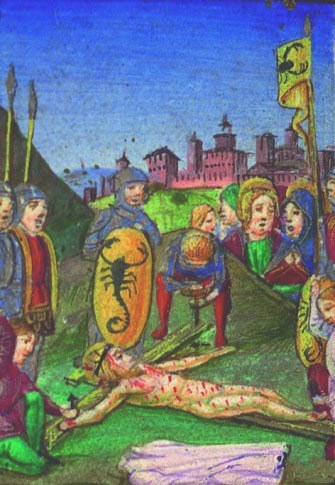
Jesus had suffered much up to this point, with his arrest, a mockery of a trial and conviction, and the severe cruelty of being flogged by the Romans. He then, in his weakened and beaten state, had been forced to walk and carry a 110-pound cross (until He could go no further and the cross was passed on to Simon of Cyrene, who had been standing in the crowd) to Golgotha.

At Golgotha, the pain was just beginning. Crucifixion, as practiced by the Romans, was a method of execution designed for maximum pain and suffering, and had been reserved for the lowest types of criminals, according to David Terasaka at BlueLetterBible.org. First, nails of at least seven inches long were driven into the small bones of the wrists, the better to support the weight. The feet also then were nailed to the cross, Terasaka said.

Then the crucified person was left to hang until he died. Terasaka said that as a person who had been crucified hung there, it became very hard to breathe because of his arms being outstretched. The muscles would also start undergoing severe cramping due to a loss of blood and oxygen.

So it was a painful way to die. Psalm 22:14-15 prophesied of the suffering Jesus would go through:

"I am poured out like water, and all my bones are out of joint. My heart has turned to wax; it has melted away within me. My strength is dried up like a potsherd, and my tongue sticks to the roof of my mouth; you lay me in the dust of death."

But the kicker in all this is Jesus' reaction. Yes, He is suffering immensely, first from the flogging and the march to Golgotha, and then dealing with being crucified itself. But He said this:

"Father, forgive them, for they do not know what they are doing." (Luke 23:34 (NIV))

Jesus knew that the people doing this to Him did not believe who He was. He knew that they had believed that He was God, they would have never done that. At the same time, though, he remained compassionate and loving toward even those who were killing Him.

In the celebration of the Stations of the Cross by Pope John Paul II in 1991, the minister prayed this prayer:

"Lord, grant us merciful hearts that we may bring your reconciliation and forgiveness to all."

Through it all, God still had the gift of mercy for His people (see John 3:16-17). Jesus wanted people to believe and repent, and return to the God who had created them and still loved them.

God still loves people today, and He wants to believe in His Son, Jesus Christ, and repent of their sins. Romans 10:9-10 says all we have to do is this:

"That if you confess with your mouth, "Jesus is Lord," and believe in your heart that God raised him from the dead, you will be saved. For it is with your heart that you believe and are justified, and it is with your mouth that you confess and are saved."

It is a matter of giving up the battle to do it all on our own. It's not a crutch, but it is the means of salvation and peace that only God can provide.

(Editor's note: This is part of a series of the Stations of the Cross.)

Friday, March 30, 2012

The Ninth Station of the Cross: Preparing to Help Others

Courtesy: Libreria Editrice Vaticana
"A large number of people followed him, including women who mourned and wailed for him. Jesus turned and said to them, 'Daughters of Jerusalem, do not weep for me; weep for yourselves and for your children. For the time will come when you will say, "Blessed are the barren women, the wombs that never bore and the breasts that never nursed!" Then they will say to the mountains, "Fall on us!" and to the hills, "Cover us!" For if men do these things when the tree is green, what will happen when it is dry?'" Luke 23:27-31 (NIV)

Members of the Church of Jesus Christ of Latter-Day Saints are encouraged by church elders to be prepared for any disaster, whether natural or man-made. That includes having things like extra batteries, water, etc., so that the family is prepared for the emergency and so they are ready to help others if need be.

As He was being led away to be crucified, Jesus encouraged the women of Jerusalem who were following Him and weeping to be prepared for hard times. In the celebration of the Stations of the Cross by Pope John Paul II in 1991, the minister prayed this prayer:

"Lord, grant us gentle spirits that we may comfort those who mourn."

In the same manner that LDS Church members prepare themselves physically and practically, we are encouraged to do the same in a spiritual matter by Jesus. He says for us to be prepared by knowing the truth of God's love and grace, and for us to have gentle spirits groomed by the Holy Spirit so that when bad times such as disasters (see the Sept. 11, 2001, terrorist attacks or earthquakes) or economic downturns (like what we are experiencing now) come around, we can be confident that God is watching out for us and we can offer that same comfort to those around us.

Jesus offers that comfort to us (see Matthew 11:28-29) and in being Christ-like or like Christ, we can offer God's comfort to others.

(Editor's note: This is part of a series of the Stations of the Cross.)

Thursday, March 29, 2012

The Eighth Station of the Cross: Answering the Call

Courtesy: Libreria Editrice Vaticana
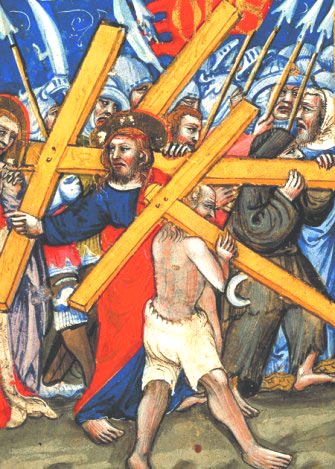
"A certain man from Cyrene, Simon, the father of Alexander and Rufus, was passing by on his way in from the country, and they forced him to carry the cross." - Mark 15:21 (NIV)

Sometimes, life will press you into extraordinary situations. Simon, as was described in the Scripture, just happened to have in Jerusalem when Jesus was receiving his punishment from the Romans. Jesus was by then weak from the loss of blood due to the brutal flogging he had received earlier as well as having had no sleep due to his being arrested. It was not certain to the Roman authorities if Jesus would even survive the trip from the prison to Golgotha, where He was to be crucified.

That was when Simon was pressed into the greatest story ever, being called upon by the Roman guards to carry the cross for Jesus.

In the celebration of the Stations of the Cross by Pope John Paul II in 1991, the minister prayed this prayer:

"Lord, grant us willing spirits that we may be your instruments on earth."

God may call us into extraordinary circumstances at some point in our lives. It may be to save another's life, or to stop an injustice from happening. We have to be willing to be open and ready to step out in that way, rather than being selfish and consumed with our own self-interest.

When we do that, then we can truly be God's instrument on earth.

(Editor's note: This is part of a series of the Stations of the Cross.)

Wednesday, March 28, 2012

The Seventh Station of the Cross: Bearing the Cross

Courtesy: Vatican Museum
"As soon as the chief priests and their officials saw him, they shouted, 'Crucify! Crucify!' But Pilate answered, 'You take him and crucify him. As for me, I find no basis for a charge against him.' ... But they shouted, 'Take him away! Take him away! Crucify him!' 'Shall I crucify your king?' Pilate asked. 'We have no king but Caesar,' the chief priests answered. Finally Pilate handed him over to them to be crucified. So the soldiers took charge of Jesus. Carrying his own cross, he went out to the place of the Skull (which in Aramaic is called Golgotha)." John 19:6, 15-17 (NIV)

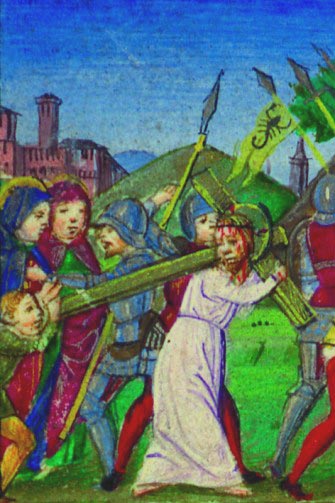
Jesus continues to suffer from a grave injustice. After being flogged 39 times by the Romans, he now is forced to carry his own cross to the place where they will crucify him.

Ponder that for a moment: Your back is cut, bruised and practically only sinew and bones after being whipped with the best (or worst) torture methods and whips the Romans had at their disposal. Then after all that, when most prisoners would have been released for their friends and loved ones to tend to their wounds, he is forced by the authorities, while half-fainting from the dramatic loss of blood, to carry a cross weighing about 110 pounds from the prison to Golgotha.

That is the price Jesus paid for our sins, even before being nailed up on the cross. Jesus knew the suffering was coming. But He also knew it was necessary. When Peter rebukes Him for saying He would be killed, Jesus replies,

"Get behind me, Satan! You are a stumbling block to me; you do not have in mind the things of God, but the things of men." (Matthew 16:23 (NIV))

The next thing is critical for our part. In the celebration of the Stations of the Cross by Pope John Paul II in 1991, the minister prayed this prayer:

"Lord, grant us strength of purpose that we may faithfully bear our crosses each day."

Jesus said that we are to bear our own crosses each day and follow Him. What does that mean? He explained that we are to lose our lives for Him. While that doesn't necessarily mean we are to die, it does mean we are to devote ourselves completely to Him, living in a way that reflects our position as children of God. That means loving others, and telling others about Jesus and who He is.

That is what is meant by faithfully bearing our crosses each day.

(Editor's note: This is part of a series of the Stations of the Cross.)

Tuesday, March 27, 2012

The Sixth Station of the Cross: Paying the Price

Courtesy: Vatican Museum
"Then Pilate took Jesus and had him flogged. The soldiers twisted together a crown of thorns and put it on his head. They clothed him in a purple robe and went up to him again and again, saying, 'Hail, king of the Jews!' And they struck him in the face." - John 19:1-3 (NIV)

To me, being flogged and humiliated like this is almost as bad as the crucifixion, especially after seeing the depiction of this scene in the "Passion of the Christ." I remember watching this scene, nearly tearing up as I saw the cruelty of the Romans as they inflicted blow after blow (For others, the tears freely flowed).

As I saw this, it brought home just what a price Jesus Christ paid for us. Remember, in the eyes of God, He had done nothing wrong. He had not sinned. In the eyes of the authorities, at least outside of the Pharisees and religious leaders of the time, He had done nothing wrong. Even Pontius Pilate, the Roman governor of Palestine, found no fault in Him, at least one worthy of punishment.

In the celebration of the Stations of the Cross by Pope John Paul II in 1991, the minister prayed this prayer:

"Lord, grant us patience in times of suffering that we may offer our lives as a sacrifice of praise."

Christians throughout the ages have demonstrated this willingness to suffer for their faith, and yet still offer praise. Many still do so today. Jesus demonstrated the way to put up with the suffering, because He knew the final outcome. He knew that in the end, God will win (start with the book of Revelation). He knew He would rise from the dead and continue to live to this day.

That is true faith and true courage, having that kind of knowledge and living by it.

(Editor's note: This is part of a series of the Stations of the Cross.)

Monday, March 26, 2012

The Fifth Station of the Cross: Seeing What's Important

Courtesy: Vatican Museum
"Very early in the morning, the chief priests, with the elders, the teachers of the law and the whole Sanhedrin, reached a decision. They bound Jesus, led him away and handed him over to Pilate. 'Are you the king of the Jews?' asked Pilate. 'Yes, it is as you say,' Jesus replied. The chief priests accused him of many things. So again Pilate asked him, 'Aren't you going to answer? See how many things they are accusing you of. But Jesus still made no reply, and Pilate was amazed ... Wanting to satisfy the crowd, Pilate released Barabbas to them. He had Jesus flogged, and handed him over to be crucified." - Mark 15:1-5, 15 (NIV)

There is a time for being quiet, and there is a time for speaking up. In this case, as he stood before Pontius Pilate, Jesus chose the quiet route. The reason? He knew they would not believe when He said He was God. As a matter, the Jews that heard Him picked up stones to stone Him (see John 10:22-33).

In the celebration of the Stations of the Cross by Pope John Paul II in 1991, the minister prayed this prayer:
"Lord, grant us discernment that we may see as you see, not as the world sees."

Jesus said that only His sheep would believe Him. He said that if we love Him, we will obey Him (see John 14:15). The way to obey Him is to speak to Him through prayer and to read His Word, the Bible, every day. It also helps to get involved with a church that preaches the Bible and its members follow what it says.

In that way, we can see things the way God sees them, and not the world.

(Editor's note: This is part of a series of the Stations of the Cross.)

Friday, March 23, 2012

The Fourth Station of the Cross: The Truth

Courtesy: Vatican Museum
"Now Peter was sitting out in the courtyard, and a servant girl came to him. 'You also were with Jesus of Galilee,' she said. But he denied it before them all. 'I don't know what you're talking about,' he said. Then he went out to the gateway, where another girl saw him and said to the people there, 'This fellow was with Jesus of Nazareth.' He denied it again, with an oath: 'I don't know the man!' After a little while, those standing there went up to Peter and said, 'Surely you are one of them, for your accent gives you away.' Then he began to call down curses on himself and he swore to them, 'I don't know the man!' Immediately a rooster crowed. Then Peter remembered the word Jesus had spoken: 'Before the rooster crows, you will disown me three times.' And he went outside and wept bitterly." - Matthew 26:69-75 (NIV)

Peter was a bold man. As Jesus predicted His death, He also predicted that all of his apostles would run away and deny Him. Peter challenged Jesus, saying He would never leave, even to the point of death. Jesus knew better, though, and predicted:

"'I tell you the truth,' Jesus answered, 'this very night, before the rooster crows, you will disown me three times.'" - Matthew 26:34 (NIV)

Of course, when Jesus was arrested, all of the disciples ran away, despite their earlier protests and promises to the contrary (see Matthew 26:56).

In the celebration of the Stations of the Cross by Pope John Paul II in 1991, the minister prayed this prayer:

"Lord, grant us the gift of honesty that we may not fear to speak the truth even when difficult."

Thanks to sin, even the most honest of us (at least by our standards) is still capable of speaking a lie, whether it is conscious or unconscious. Peter and the other apostles were very bold in protesting when Jesus predicted their falling away, but that was also at a time of very little trouble. When the real trouble came, they fell away almost too quickly.

We need to ask God to continue to work in us so we may not only be honest and speak the truth in the best of times, but also when we may, as they say, bite the bullet and say it when it is difficult. 1 Timothy 3 tells us that overseers (also can be defined as church leaders) must be above reproach, or good to the point of being beyond criticism because we are acting like we are speaking and doing what we should be doing, bringing glory and not shame to the name of Christ.

May we all be able to do that.

(Editor's note: This is part of a series of the Stations of the Cross.)

Thursday, March 22, 2012

The Third Station of the Cross: Being Right

Courtesy: Vatican Museum
"At daybreak the council of the elders of the people, both the chief priests and teachers of the law, met together, and Jesus was led before them. 'If you are the Christ,' they said, 'tell us.' Jesus answered, 'If I tell you, you will not believe me, and if I asked you, you would not answer. But from now on, the Son of Man will be seated at the right hand of the mighty God.' They all asked, 'Are you then the Son of God?' He replied, 'You are right in saying I am.' Then they said, 'Why do we need any more testimony? We have heard it from his own lips.'" - Luke 22:66-71 (NIV)

Before the Sanhedrin, Jesus knew what He was going up against. He knew that under Jewish law, especially the way it was interpreted by the Pharisees, admitting He was the Son of God would gain him death. He knew He would not be believed because the Pharisees chose not to believe. However, when asked, He admitted it, answering "Yes" to the question, "Are you then the Son of God?"

In the celebration of the Stations of the Cross by Pope John Paul II in 1991, the minister prayed this prayer:

"Lord, grant us your sense of righteousness that we may never cease to work to bring about the justice of the kingdom that you promised."

In this life, we're going to face opposition. We're going to face persecution if we stand for something. If we're going to face opposition, we had better make sure we're facing it for a good reason.

As Christians, as followers of Christ, we know that if (and when) we face opposition and persecution, as millions of Christians do across the world, we can face it with the faith that Jesus is who He said He was: He was God (see John 14:7-10, John 10:28-33, John 14:11, among others) and that with His death on the cross, he even fulfilled Scripture (see Isaiah 53).

For that reason, we can be certain we are right in the cause we pursue, and face it with confidence, perseverance and courage.

(Editor's note: This is part of a series of the Stations of the Cross.)

Wednesday, March 21, 2012

The Second Station of the Cross: Reflecting the Good News of Christ

Courtesy: Vatican Museum
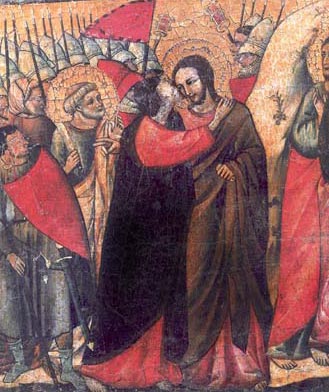
"Just as he was speaking, Judas, one of the Twelve, appeared. With him was a crowd armed with swords and clubs, sent from the chief priests, the teachers of the law, and the elders. Now the betrayer had arranged a signal with them: 'The one I kiss is the man; arrest him and lead him away under guard.' Going at once to Jesus, Judas said, 'Rabbi!' and kissed him. The men seized Jesus and arrested him." - Mark 14:43-46 (NIV)

In the celebration of the Stations of the Cross by Pope John Paul II in 1991, the minister prayed this prayer:

"Lord, grant us the courage of our convictions that our lives may faithfully reflect the good news you bring."

Ever since the beginning of His ministry on Earth, Jesus knew Judas Iscariot was going to betray Him. He said as much at the Last Supper (see Matthew 26:23-25).

But Jesus knew the Father had said for Him to sacrifice Himself for the sins of the world, as part of His plan of salvation. Even when He was being arrested, He stopped His apostles from doing more than slicing the ear off the servant of the high priest, which he later healed (see Luke 22:49-51). Jesus wanted peace, even though He knew what His fate was going to be. However, He also knew that He would rise from the dead in three days (see John 2:18-22).

Since then, followers of Christ have done just that, bore up under intense persecution for their faith. Even today, followers in parts of Asia, Africa and the Middle East must suffer for their faith of the saving grace of Jesus Christ. However, they continue to do so in a peaceful manner, because they, like Jesus, know how the story ends.

Like the minister in the celebration said, may our lives faithfully reflect the good news that Jesus brought.

(Editor's note: This is part of a series of the Stations of the Cross.)

Tuesday, March 20, 2012

The First Station of the Cross: Praying for God's Will

Courtesy: Vatican Museum
"Then Jesus went with his disciples to a place called Gethsemane, and he said to them, "Sit here while I go over there and pray." He took Peter and the two sons of Zebedee along with him, and he began to be sorrowful and troubled. Then he said to them, "My soul is overwhelmed with sorrow to the point of death. Stay here and keep watch with me."Going a little farther, he fell with his face to the ground and prayed, "My Father, if it is possible, may this cup be taken from me. Yet not as I will, but as you will."Then he returned to his disciples and found them sleeping. "Could you men not keep watch with me for one hour?" he asked Peter. "Watch and pray so that you will not fall into temptation. The spirit is willing, but the body is weak." - Matthew 26:36-41 (NIV)

(Editor's note: This is part of a series on the Stations of the Cross.)

In the Garden of Gethsemane, which is located at the foot of the Mount of Olives just east of Jerusalem, Jesus met with his disciples for the last time. He knew what was coming up, that He would soon endure a death He did not deserve.

In the celebration of the Stations of the Cross by Pope John Paul II in 1991, the minister prayed this prayer:

"Lord, grant us your strength and wisdom, that we may seek to follow your will in all things."

God knows life can be hard. Jesus, though He could get out of sacrificing Himself on the cross because He was God Himself, didn't, instead relied on God the Father for the strength to persevere. He asked for the Father to take "this cup" from Him, but He also relented.

"Yet not as I will, but as you will." - Matthew 26:41 (NIV)

He asks that of us as well. He knows there are temptations in the world. He knows there are hardships that we all face. But through it all, He says for all of us to follow Him, and to rely on God for that strength and for answers.

Friday, March 16, 2012

Christ for all

Courtesy Prison Fellowship International
"There is neither Jew nor Greek, slave nor free, male nor female, for you are all one in Christ Jesus" - Galatians 3:28 (NIV)

More and more often these days, Christians are accused of being prejudiced against gays and lesbians, women, and those of other faiths. They are accused of wanting to impose a system where the tenets of the Bible are obeyed and enforced with an iron fist.

In some cases, those making those kind of accusations would be correct.

Prejudice such as racism and religious discrimination is one of the biggest ills in the world, even in the church. Bigotry has been used throughout history to enslave people, figuratively through laws or physically through chains, to bring them down, or in general, make them second- or third-class citizens. There is the racism that was prevalent in the United States that in some sectors, still exists today. There is the denial of freedom to choose and practice your own faith that is rampant throughout much of the Middle East and other parts of the globe.

However, in Christ, for those who actually follow His teachings, that prejudice is history, part of a sinful past that has been abolished by the saving blood of our Savior. For those believers who allow Christ to take hold in their lives and actually strive to follow the teachings outlined in God's Word, the Bible, it is a freedom from bigotry that can ensnare both the people they are directing it toward and themselves as well.

Yes, Christians can call out sin amongst in the world. However, they are called to love others as God loved them (see Ephesians 5:1-2), and follow Christ's example. Throughout the Gospels, Jesus called out the Pharisees and other religious leaders of the day for their sins. However, for others, he simply loved them, welcoming them and healing them of the their physical and spiritual wounds caused either by bad teaching or their own sinfulness.

The evangelist Billy Graham is one such person. During his more than 60 years of active ministry, he was able to preach in closed countries such as Eastern Europe and the former Soviet Union during the days of communism, and meet with leaders such as North Korea's Kim Il Sung and other presidents because he simply lived and preached the saving Gospel of Jesus Christ with no other agenda. During a crusade to India in 1956, his first evangelistic trip to somewhere besides the United States or Western Europe, he made the following the distinction about Jesus, as noted in his autobiography, "Just As I Am:"

"I am not here to tell you about an American or a Britisher or a European. I am here to tell you about a Man Who was born right here in your part of the world, in Asia. He was born at the place where Asia and Africa and Europe meet. He had skin that was darker than mine and He came to show us that God loves all people. He loves the people of India and He loves you."

Jesus Christ is for all people, regardless of who they are and what they have done. All you have do is reach out to Him, because He is reaching for you. If you have questions or would like to talk about Christ, please feel free to contact me.

Links in the news

  • Saint Patrick, whose days we mark on Saturday, was a practical theologian and social activist, a man truly ahead of his time.
  • The Islamic-led government in Sudan, following last July's succession by its mainly Christian and animist southern regions, has decreed that all Christians must leave the country or suffer the consequences.
  • Mail deliverers in Israel outside of Tel Aviv are refusing to deliver Hebrew-language New Testaments being given away by a unknown group.

Tuesday, February 28, 2012

WANTED

WANTED: Missionaries and church planters

Matthew 28:19-20 tell us, "Therefore go and make disciples of all nations, baptizing them in the name of the Father and of the Son and of the Holy Spirit, and teaching them to obey everything I have commanded you. And surely I am with you always, to the very end of the age."

Some have devoted their lives to this, living behind family, friends and familiar places to go off to distant places in the United States and beyond to tell others about Jesus Christ. These are those who have decided to dedicate their lives completely to serving in a particular place and spend the bulk of their waking hours telling others about the love and forgiveness of Jesus Christ.
It doesn't matter whether they are doing it outside of the United States or picking a spot in this country to minister. The Disciple Beacon is looking for missionaries and church planters who are willing to talk about their experiences and why they do what they do.

The easiest way to introduce yourself would be to contact the editor of the Disciple Beacon.

I would love a chance to write these fine people and interview them for a bit on this site about their experiences and what motivates them.

Thank you and God Bless!

Monday, February 27, 2012

'Let others know what you have seen'

"Jesus said, "Do not hold on to me, for I have not yet returned to the Father. Go instead to my brothers and tell them, 'I am returning to my Father and your Father, to my God and your God.' " - John 20:17 (NIV)

It had been a time of sorrow for the followers of Jesus.


Their leader, the man they believed to be the Messiah, was dead, crucified at the hands of the Romans and the Jewish religious leaders of the day. Howver, when two women came to dress Jesus' body for final burial, they discovered the tomb was empty.


Obviously, the women who first made this discovery and later Peter and the other disciple who came to investigate had reason to be concerned. They knew that people would say that Jesus' followers had come and taken the body so they could say He had been resurrected (indeed, the Jewish religious leaders worried about this happening that they convinced Pontius Pilate to post a guard outside of the tomb).

But Jesus slowly made Himself known to His followers, particularly to Mary Magdalene, who had been one of His earliest students. She had remained at the empty tomb crying, and was desperately hoping that whoever had taken Jesus' body would return it so the persecutions from the religious leaders and the Roman authorities would ease up.

He tested her by asking why she was crying, to make sure that indeed it was Him that she was looking for, that she hadn't turned away like others had when He was arrested and later crucified. When He revealed Himself to her by merely saying her name, she knew right away that her hopes that He had been right all along about His pending resurrection was true, that her and others' following of Jesus, who they believed the long-awaited Messiah, had not been in vain.

However, Jesus also told her to not just sit there, but to go and tell the others what she now knew to be true. He said to not just hold on to Him, but to let the others what she knew to be true.

That is the call to the church today as well. Too often, religion is to be a private matter so not to offend others.

If we know something to be true, something that is so unbelievable, that our merely having faith and putting our trust in it has eternal implications, then we are obligated to say something about it. We are to tell others that not only isn't Jesus not dead and buried, but also alive and eventually, coming back.